After Cultural Diplomacy
30 June 2026
Elena Polivtseva
Culture: the last space for dialogue?
The world order is changing faster than we have had time to make sense of it. The number of cross-border conflicts has reached levels unseen since the end of World War II, geopolitical partnerships are being questioned, and long-standing trade relations are being overturned. The development aid has been under pressure, while the digitalisation boom is increasingly discussed in terms of international dependency rather than global progress.
In this context, Europe wants greater control over its future and a stronger voice in global affairs, going so far as to title the European Commission’s 2026 Work Programme Europe’s Independence Moment. The focus is on becoming more self-reliant in technology and security, boosting economic competitiveness, protecting borders, and maintaining peace. The European Union has also committed to revamp its international cultural relations strategy in the coming years, positioning itself as a ‘global cultural powerhouse’ and a ‘global leader in culture and creativity’.
Indeed, while existential concerns around security are dominating policy-making, culture has not been brushed aside as non-essential. One unexpected example was the highlight of the Munich Security Conference earlier this year — the speech by Marco Rubio, the US Secretary of State. He won over some audiences by arguing that today’s stakes are not only about military defence, but also about what exactly there is to defend — the shared culture of ‘Western civilisation’, invoking Shakespeare, Mozart, The Beatles, and The Rolling Stones. Another example of geopolitisation of culture is Russia’s revival of the Intervision Song Contest, originally conceived in the 1960s and dormant for decades. This maneuver has clearly been an attempt to create a geopolitical counterweight to the Eurovision Song Contest and its liberal value systems.
While in many of these and similar cases culture is hyper-instrumentalised in service of specific political narratives, often at odds with the values of the arts community itself, it is clear that culture has regained importance in the arena of geopolitical struggle.
At the same time, it has become clear that cultural diplomacy in its traditional form is no longer working. Earlier this spring, we witnessed how nation-branding through art — disguised under the notion of art as a neutral and apolitical space — ultimately serves neither art nor diplomacy particularly well. At the Venice Biennale, protests and institutional tensions intensified around the participation of Russia and Israel. The five-member jury announced it would not award prizes to artists from countries whose leaders are currently charged with crimes against humanity by the International Criminal Court before resigning altogether and leaving the Biennale without its traditional Golden Lion awards. Workers went on strike on the eve of the opening — the first in the event’s history — with several pavilions closing in solidarity. Similarly, at the 2026 Eurovision Song Contest, Israel’s participation sparked protests, boycott campaigns, public criticism from broadcasters, artists, and former participants, and demonstrations in the host city.
Those who criticise boycotts and fear the politicisation of culture that comes with them often invoke “dialogue” as culture’s highest mission. Yet it has become visible that dialogue cannot be manufactured through symbolic coexistence alone. Dialogue — including through art — only becomes possible once there is readiness for it. Refusal, withdrawal, and disruption can themselves become conditions for creating that readiness. However, there is little room for meaningful dialogue inside nation-branding events that claim neutrality while continuing to embody the logic of ‘business as usual’ amid war and breaches of international law.
When cultural diplomacy is pursued in its usual state-led shape in the world as it is, contradictions become unavoidable. If cultural events choose to stage geopolitics through flags, nations, and symbolic representation, they cannot simultaneously expect geopolitics to remain outside the room. Conflict, friction, protest, and moral confrontation become the logical consequence of the structures on which these events are built. But what is failing is not cultural diplomacy itself, but a narrow version of it that reduces culture to national display, symbolic coexistence, and soft-power projection. Equating cultural diplomacy with this model risks confusing the failure of nation-branding with the failure of culture’s international role altogether.
In contrast to the Venice Biennale and the Eurovision Song Contest, the Cannes Film Festival was not overshadowed by geopolitical confrontation to the same extent. This is partly because the festival is structured less around direct inter-state competition and more around international co-production and artistic circulation.
Another element defining today’s state of cultural diplomacy is the global decline of democracy, compounded by the growing militarisation of geopolitics. Today, autocracies outnumber democracies for the first time in 20 years. This has resulted in growing censorship across large parts of the world, along with increasing restrictions on artistic expression that challenge dominant state ideologies or political narratives.
In this reality, it is becoming increasingly difficult for artists to bring their art across borders, especially in contexts where political values diverge, and restrictions tighten. Presenting one’s work — especially in government-led contexts — is no longer as innocent or safe in countries that, until recently, seemed like natural or acceptable destinations for artists. The free movement of ideas, values and artworks is no longer as straightforward as it once seemed. The world has become increasingly divided into smaller geopolitical spheres, each with its own accepted artistic values, cultural narratives, and boundaries of expression. Tariffs and military coalitions are further fracturing global cultural exchange and art markets.
Meanwhile, as The Economist reports, cultural consumption has become increasingly fragmented. The vast abundance of content enabled by streaming platforms allows global audiences, more than ever, to assert local preferences. Netflix increasingly invests in hyper-local stories for local audiences, producing, for the first time, more content in languages other than English. Even music streaming algorithms, contrary to the dominant narrative about their homogenising effect, often push listeners into niche ecosystems, leading them to engage more with local artists.
So, what now? Are we at a point where we realise that culture is not capable of being the last space for ‘dialogue’ we once hoped for, and that it cannot help us collectively imagine a different, better world? As Joshua Citarella suggested, are we witnessing a lack of ‘confidence in art’s ability to communicate across spheres’, and have artists themselves — when withdrawing from problematic contexts, lost the ‘faith in contemporary art as a form of discursive exchange’?
The truth is that the most meaningful artistic dialogue is still happening, but most often beyond the sphere of state-led cultural relations. It happens through bottom-up transnational collaborations, co-productions, informal networks, and alliances between artists who come together across borders not to celebrate diplomacy, but to collectively confront global questions and be in solidarity with each other. When art escapes flags and borders, it regains its radical power: to unite people, confront urgent realities, and imagine new worlds.
The controversies and backlash surrounding state-led cultural events are accelerating a debate that was already emerging: toward more transnational curation, post-national forms of cultural representation, artist-led rather than state-led participation, and networked models of exchange instead of predominantly ‘pavilion diplomacy’. But in today’s reality of the global democratic decline, this debate is not merely about allowing art to globalise — it is more about imagining how art can continue to transcend borders and be the real ‘global public good’ as labeled by UNESCO in 2022, while resisting the global rise of censorship and geopolitical fragmentation. Artistic freedom increasingly means treating art as a borderless inquiry into worlds that do not yet fully exist, rather than primarily as a tool of national representation.
The endless project-to-project showcasing of artistic work — as carriers of values, narratives and symbols — across both a globalised and fragmented world is no longer sustainable, nor is it always possible. What, then, should replace it? If the traditional paradigm of cultural diplomacy is increasingly proving inadequate, what might a new one look like?
This question is best asked to artists and art institutions themselves. How would artists shape global collaboration on their own terms, beyond the logic of 'cultural diplomacy'? What happens with cross-border cultural collaborations when a funder replaces control with radical trust? And when ‘projects’ stop being treated as the default unit of artistic value? What if cultural funders take time to enable the art field to experiment and construct the translational relational infrastructure artists truly need — on their own terms, and then learn from this and embrace the outcome as the new global cultural relations paradigm?
What if trust in the arts becomes real?
Several years ago, the Nordisk Kulturfond (Nordic Culture Fund), an intergovernmental body supporting artistic and cultural collaboration across the Nordic region, asked these very questions and responded by launching an experimental funding scheme: Globus.
Globus was the Fund’s multi-year initiative running from 2020 to 2025. It aimed to expand Nordic cultural collaboration beyond the region by supporting partnerships with actors worldwide. Globus emerged from the recognition that new ways of working across borders were already taking shape within the cultural field — ways that connect global and local agendas while moving beyond the national lens. In earlier programmes, national anchoring in a Nordic country was an important eligibility criterion. Under Globus, however, it became clear that such requirements could constrain transnational collaboration. The Fund observed that in today’s interconnected world, especially amid growing nationalism, the national framework no longer necessarily reflects how cultural collaboration actually operates.
Globus explicitly challenged this logic through its own definition of the global: ‘We view the global as borderless — the world as a united whole’. Borders appeared increasingly alien to the nature of artistic and cultural exchange, making the national lens in funding structures seem more like an imposed construct than an organic reality.
The open calls did not require applicants to address predefined themes, represent specific countries, or provide fixed answers about the Nordic region’s place in the world. Instead, by simply enabling partnerships beyond the Nordic region — anywhere in the world, while maintaining a Nordic anchor, the programme created a practical experiment in exploring how the region’s relevance might emerge within global collaboration.
Crucially, Globus focused less on what would be produced and more on why partners wished to collaborate and how the collaboration would function — both during and beyond the funded period. Assessment criteria focused on mutual commitment, role clarity, reciprocity, inclusivity, and sustainable collaboration structures. Reviewers were encouraged to assess the authenticity and depth of partnerships, their sensitivity to local contexts, and the extent to which collaboration was genuinely equitable.
The Fund also recognised that meaningful innovation requires risk and the funder’s trust. As a result, the goal was not to fit applicants into rigid frameworks, but to encourage reflection, lower barriers to access, and continuously adapt funding criteria through learning. Application and evaluation processes, which were comparatively light, focused less on formal compliance and more on the integrity of collaboration: how decisions were shared, how budgets were structured, and how resources were distributed among partners. Open-ended trajectories were encouraged, and beneficiaries were free to adjust them along the way, provided the changes were justified.
I had the chance to support the Fund in consolidating the key learnings from this experiment. Our exercise resulted in two report series ‘Funding Culture for a Changing World’, in which the learnings of Globus, situated within a broader policy analysis, offer lessons for understanding what kinds of global collaborations make the most sense and how cultural funding can become more relevant.
We have analysed the initiatives that were born out of the Globus funding framework — their dynamics, ambitions, aspirations, practical realities and lived experiences. So, what kind of international cultural relations paradigm emerges when artists are trusted to engage in global collaborations on their own terms?
1. Art becomes a collective inquiry
Driven by shared curiosity about issues that resonate globally, many Globus projects functioned as collective research journeys, or inquiries — exploratory trajectories, unfolding through experimental artistic and research practices. In this model, artistic practice functions as a method for collectively asking global questions across contexts — for instance, looking at imbalances in ecological responsibility and exposure to environmental threats; exploring censorship, displacement, and labour precarity; or reframing historical narratives and traditions through Indigenous methodologies. If national borders matter at all in these inquiries, the goal is not to position or promote specific states within these collaborations, but to define countries’ places, roles and responsibilities within larger global debates and processes.
Across projects, there is a recognition that more multi-vocal knowledge systems are urgently needed, particularly in light of the current global polycrisis. That is why knowledge was treated as place-based, historically situated, and emancipated from dominant Eurocentric paradigms. Rather than transferring expertise from one context to another, collaborators jointly develop questions shaped by local urgencies and global entanglements. This model challenges more extractive forms of collaboration in which one partner benefits disproportionately from visibility, knowledge, or funding. Instead, the projects foreground co-creation, reciprocity, and accountability, ensuring that inquiry remains meaningful to all participants.
2. The ‘international’ becomes ‘translocal’
Another significant feature evident across bottom-up cross-border collaborations is the move from a traditional notion of the ‘international’ toward a translocal approach. Instead of facilitating exchange between nation-states or flagship institutions, these initiatives link specific places, communities, natural systems, or practices situated in different places across the world. Translocal collaboration within Globus prioritised long-term relationships between particular sites, such as Arctic villages and tropical communities, rural Japan and Norway, Indigenous territories across continents, and diasporic communities. This perspective recognises that global challenges, such as climate change, extractivism, migration, censorship or technological transformation, are always experienced locally, but never in isolation.
Connecting localities that face similar pressures, translocal collaboration enables comparative learning without flattening differences between contexts. Translocal collaboration often operates through shared formats and concepts that travel across localities and are adapted to local contexts while maintaining collective ownership. Translocal collaboration, therefore, also implies decentralisation of authorship, agency, and control. Works are not fixed products presented to local communities, but evolving processes shaped collectively, in tune with local dynamics.
At the same time, the national dimension has not disappeared in practice: it does matter what passports partners hold and where they are based in the world. Visa issues remained a significant challenge for many projects. Partners encountered different levels of risk depending on political contexts, and when travelling to fragile environments, individuals faced different risks depending on their nationality. The paradox lies in the fact that although artists’ practices are increasingly embedded in global and local dynamics, rendering national borders seemingly artificial, national frameworks remain more present than ever in the practical realities of cultural production.
3. Working across borders becomes a practice of fairness
Across the projects, beneficiaries articulate a clear understanding that while conditions differ significantly across contexts, the reality of polycrisis is shared. Ecological collapse, economic instability, nationalistic politics, and the instrumentalisation of culture affect many regions, though unevenly. Collaborations, therefore, often emerge from a recognition that partners are confronting interconnected challenges from different positions.
However, the awareness about inequities is reflected in the structures many projects adopt: reciprocal governance arrangements, flexible participation models, attention to labour conditions and fair compensation, and an emphasis on local agency. Collaborations often became spaces where questions of fairness, responsibility, and value were explicitly negotiated. This sometimes involved discussions around salary parity, redistribution of resources, or recognition of non-financial contributions such as knowledge, networks, or local legitimacy. Projects repeatedly encounter different rhythms of urgency and delay: contexts where speed is necessary for survival and others where slowness is essential for building trust; bureaucratic, post-conflict, or hierarchical temporalities; and asynchronous political, ecological, and cultural moments.
Globus beneficiaries also acknowledged the limits of what asymmetrical collaborations could achieve. Structural inequalities often persisted despite efforts to work equitably. The overall instability of cross-border projects—often forced to pause or cease once funding ends—also raises questions about their longer-term structural impact, particularly in fragile contexts. Yet, even if not delivering lasting structural change, many projects functioned as awareness-raising interventions revealing inequities, linked to visa barriers, resource gaps, and political or academic ignorance.
4. Collaboration becomes an infrastructure for collective freedom
In a fractured world marked by the ongoing collapse of democratic values, it is no longer enough and not always possible to simply move artworks from place to place and double down on artistic visibility. Instead, the most urgent form of cultural collaboration has become the collective construction of transnational spaces of solidarity, freedom, and resistance. Globus projects have clearly shifted the lens on cross-border cultural collaboration from one of showcase toward building spaces for withstanding and critically engaging with global power structures. Across the projects, artists and organisations address issues such as colonial legacies and extractivism, censorship and artistic repression, war and displacement, geopolitical crisis, and the global decline of freedoms. In this context, focus on relationship building and networks is not surprising — relational infrastructures allow artists to sustain their practices under conditions of repression, recover from censorship, and maintain dialogue across politically fractured environments.
5. Global collaboration is more than a sequence of projects
A key pattern across the Globus projects has been a strong emphasis on infrastructure-building rather than one-off artistic outputs — a clear departure from a project-based model. Infrastructure here is understood in a broad sense, encompassing platforms, networks, pedagogical models, material workspaces, working methods, and shared resources that enable sustained collaboration beyond individual funding cycles. The shift in focus from producing visible outputs toward strengthening the foundations of collaboration responds to a growing need for solidarity amid increasing political and economic barriers to international cooperation. This orientation toward infrastructures also reflects a broader recognition that meaningful transnational collaboration depends on continuity, trust, shared tools and languages, and organisational capacity.
Globus-supported activities demonstrate a plurality of implementation models, but also a shift in how ‘projects’ as such are understood. In practice, both network-building and project-type trajectories tend to coexist within the same initiatives. What differs is their central focus: in some cases, the relationship itself forms the core purpose, with outputs, such as productions, reports, or events, serving as connecting nodes. In others, these specific interventions constitute the main objective, while the collaboration functions as the supporting infrastructure enabling these actions.
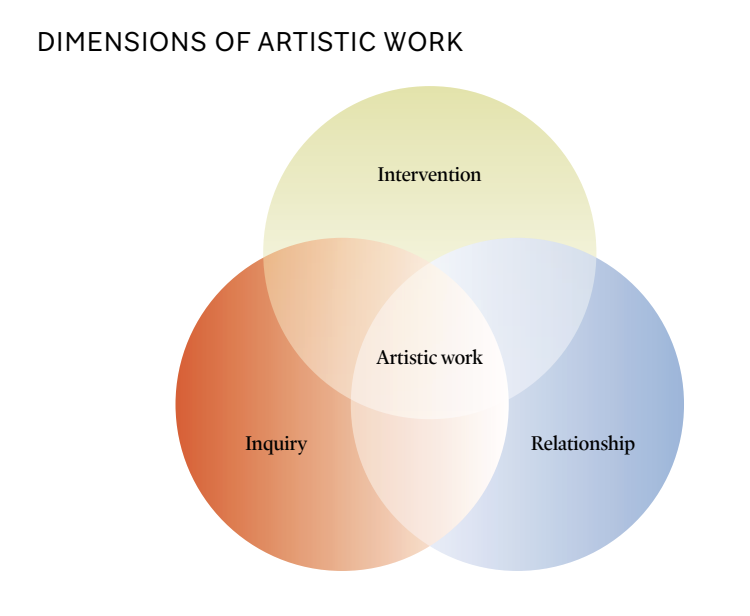
To envisage a balanced funding programme, we need to ask the question: how do we understand artistic work in the first place?
Artistic work unfolds through a constellation of three elements:
relationships — networks, partnerships, collaborations;
inquiry — process, exploration, experimentation;
and intervention — outputs such as performances, exhibitions, films, etc.
Image source: Volume 1: Learning from the Globus Experiment - Funding Culture for a Changing World
These dimensions are mutually reinforcing. While art often begins as inquiry, it gains wider relevance when it materialises through concrete interventions, which are only possible within a robust ecosystem composed of relationships, networks, capacities, and resources. This perspective suggests the need to rebalance what funders recognise and support within artistic practice. Products, research processes, and relationship-building are all essential nodes in artistic work and should be valued accordingly. However, the importance of these elements varies across contexts and over time: what requires support largely depends on what is most urgently missing in a given context. The key is not to completely move away from project- and output-driven trajectories, but to ensure a balanced valuation of all three elements.
6. Regional identity becomes a process — and an open question
One of the key questions of the Globus trajectory was: what kind of Nordic relevance can emerge in today’s global realities? Nordic artists and cultural organisations were free to engage with partners from across the world and undertake activities that mattered to the collaboration both globally and locally. The Fund, in its turn, sought to understand what role and identity for the Nordic region could emerge through these bottom-up collaborations.
We learned from Globus that Nordic relevance is not a stable identity but a concept in motion. The programme itself functioned as a provocation against fixed understandings of regionality, enabling Nordic actors to work globally and address any topics that mattered most for their specific project. This approach did not produce a single definition of Nordic relevance. Instead, it framed it as an ongoing exploration emerging through collaboration, critical reflection, readiness to continuous transformation, and global interdependence. Across projects, the Nordics are framed less as a model to export and more as one context among many, characterised by responsibility and structural implication in global developments, situating the region as both supporter and learner within an evolving global field.
This lens shows how cultural policy can shift away from using culture to preserve a fixed regional identity toward actively redefining the region’s role, responsibilities, and relevance in a rapidly changing world. Therefore, Globus served as a method — a living process through which the Nordic idea is explored and developed. Can this be an approach from which Europe as a whole could learn?
Conclusion
In his article ‘A Multipolar Art World?’ Joshua Citarella wrote: ‘Art is a unique social space. It allows for forms of cultural exchange that may be impossible or prohibited in other spheres. It is not something from which we should easily retreat or surrender. Globalization, as we have known it, may be over. Whatever comes next might be worse. Yet the project of shaping a universal society, organized by human values, is ever present and ongoing. I believe that art will play an integral role in this process.’
The European Union is preparing to renew its international cultural relations strategy in the coming years, and the urgency of this exercise is clear. What remains uncertain is how the EU intends to reconcile its competing narratives: as a “global cultural powerhouse,” as a geopolitical actor seeking strategic autonomy, competitiveness, and digital sovereignty, and as a champion of bottom-up, people-to-people cultural exchange. Can these ambitions truly form a coherent and visionary whole?
In an era marked by propaganda, misinformation, culture wars, rising borders, and the return of hard-power politics, the question is whether the EU’s cultural relations strategy can sustain a distinct space for artist-led global dialogue about a future world better than today’s. Fundamentally, it is how policy can create conditions in which artists and cultural organisations remain free, while government actors still provide resources, protection, and long-term infrastructure.
What kind of paradigm of international cultural relations would emerge for the EU then? Can it be that this paradigm lies precisely there: in trusting artists with the freedom to shape that paradigm themselves? Trust in the cultural sector could itself become a powerful statement — a defining marker of the EU’s cultural policy. Trust in culture does not require the absence of strategy or policy; rather, it requires a profound understanding of when to step back and how to provide the support most relevant to specific needs and contexts.